
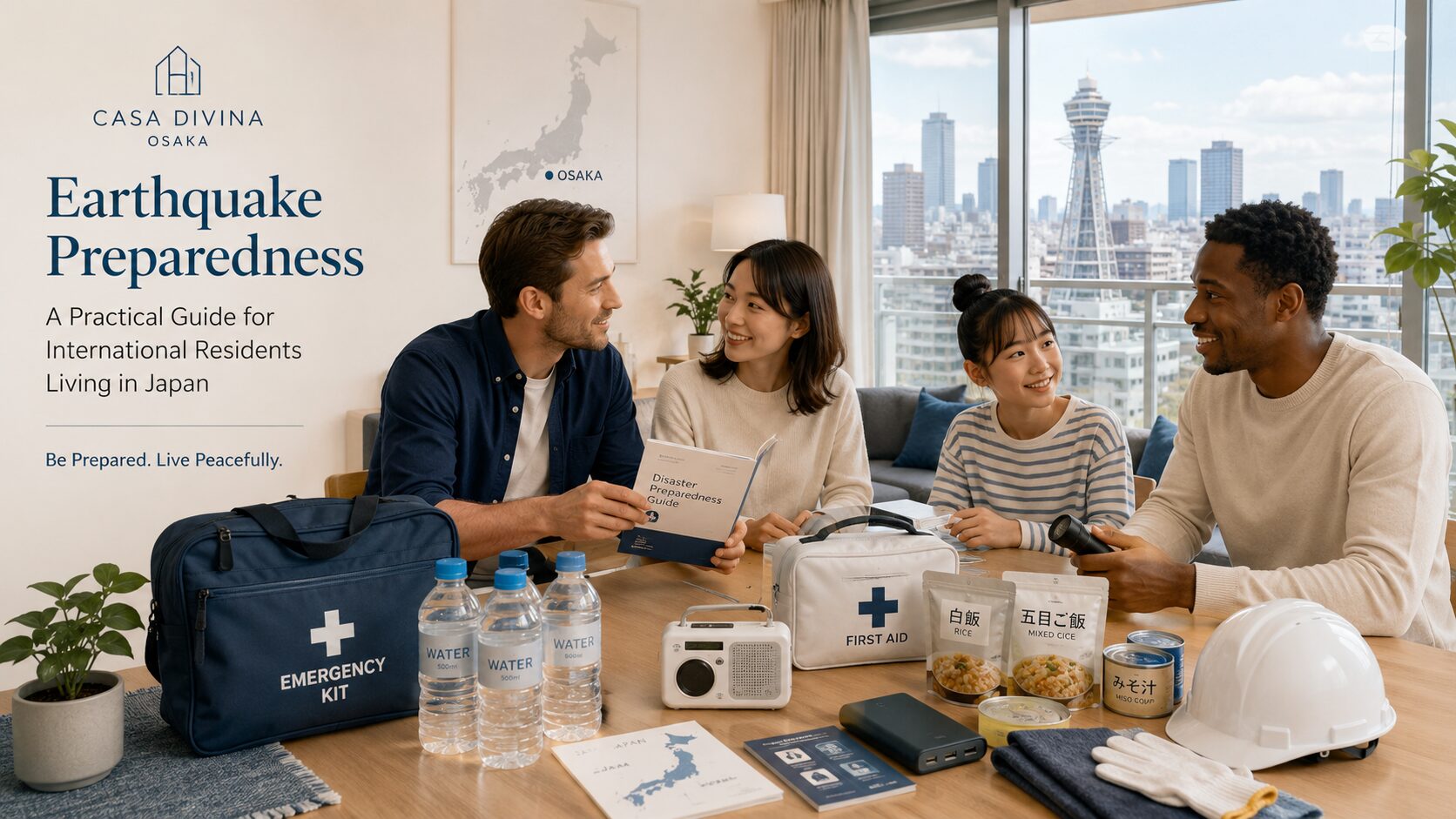
THE KIND OF CALM, PRACTICAL DISASTER PREPAREDNESS CASA DIVINA OSAKA BELIEVES IN
Recently, one of our clients connected to a foreign consulate in Osaka shared a concern that many people around them have been feeling: anxiety about earthquakes.
Even for those of us who have lived in Japan for many years, earthquakes are never a light matter. For foreign residents, diplomats, and families newly arrived from overseas, terms such as “seismic intensity,” “tsunami,” and “Nankai Trough” can create a great deal of unease.
Whenever I travel abroad, I also feel a certain tension. Language, systems, emergency information, evacuation sites, medical care, transportation. Things that local residents understand naturally are not always immediately clear to someone from another country.
That is exactly why Dios / Casa Divina Osaka believes its role goes beyond simply providing a residence. We believe that helping our clients live safely and comfortably in Japan also includes practical guidance on daily life, disaster information, and basic emergency preparedness.
WHAT WE WANT TO SAY FIRST
Before anything else, we would like to make our position clear.
There are real questions surrounding the high probability figures and time-based prediction models often used in discussions of a possible Nankai Trough earthquake.
Precise earthquake prediction, in the sense of accurately specifying the time, place, and scale of a future event, is not something current science can reliably do.
At the same time, Japan is a country where earthquakes can happen.
For that reason, we believe it is not wise to frighten people by saying, “It will definitely happen soon,” and it is equally unwise to reassure people by saying, “It will never happen.”
The important thing is to remain calm, think clearly, and prepare in practical ways.
RECENT DISCUSSIONS AND WHY THEY MATTER
In Japan, the possibility of a major Nankai Trough earthquake has long been discussed using phrases such as “a high probability within the next 30 years.”
However, the numbers behind these statements, and the models used to produce them, have also been questioned by some researchers. There are experts who argue that the assumptions behind these models are uncertain, that the calculations depend on contestable premises, and that different methods could produce significantly lower figures.
In other words, the existence of a high number does not automatically mean that the future is known with certainty.
For us, the key point is not to settle an academic argument in a simple blog post.
The key point is this: earthquake-related numbers and forecasts include uncertainty, and they should not be treated as unquestionable truth.
THE NANKAI TROUGH SHOULD NOT BE TREATED AS A CERTAINTY
We believe the Nankai Trough should be discussed with care.
If people hear only that it is certain, immediate, and unavoidable, fear can quickly replace judgment.
On the other hand, it is also not reasonable to conclude that because it has not happened recently, it will never happen.
What we can say is more modest, but more honest.
There are serious questions about whether anyone can confidently state that a Nankai Trough earthquake is highly likely within a specific time frame.
But that does not mean earthquakes will not occur in Japan.
These two ideas are not contradictory.
What we want to avoid is a situation in which the phrase “Nankai Trough” becomes a source of either excessive fear or careless complacency.
EARTHQUAKE PREDICTION IS NOT CURRENTLY POSSIBLE IN THE WAY MANY PEOPLE IMAGINE
For many years, people hoped that earthquakes might one day be predicted in advance.
But despite long research efforts, there has still been no reliable way to identify the exact timing, location, and scale of a major earthquake.
Many supposed warning signs may seem persuasive after an earthquake has already occurred. But that is very different from proving in advance that they can predict one.
This is especially important for international residents.
Statements such as:
“It will happen on this date.”
“This area alone is in danger.”
“After this day, it will be safe.”
These messages may sound reassuring or dramatic, but they often create confusion rather than clarity.
Earthquakes are not that simple.
That is why it is more practical to prepare for the possibility of earthquakes in general, rather than to place trust in specific predictions or rumors.
SCIENCE, POLICY, AND INSTITUTIONS ARE NOT ALWAYS SEPARATE
Recent discussion has also raised another difficult issue.
Some critics argue that earthquake-related public messaging is shaped not only by science, but also by government systems, advisory committees, funding structures, disaster policy, and institutional priorities.
This is a sensitive subject, and it should be approached carefully.
We are not interested in making reckless accusations against specific individuals or organizations.
But it is reasonable to recognize that scientific information in society is often shaped through many layers: research, administration, budgeting, public policy, and media communication.
For that reason, it is wise for readers to receive official numbers and statements with calm attention, rather than unquestioning belief.
This is not about encouraging distrust.
It is about encouraging balance.
HAZARD MAPS ARE IMPORTANT, BUT THEY ARE NOT PERFECT
Hazard maps and risk maps are useful tools.
But they are still tools, not absolute forecasts.
Real earthquakes do not always occur in the places people expected most strongly. Sometimes serious earthquakes happen in areas that were not emphasized. Sometimes places long discussed as high-risk remain quiet.
So hazard maps should be treated as practical references, not as perfect predictions.
For international residents, this is particularly important to understand.
You do not need to panic because a map shows risk.
But you also should not assume that an area is completely safe simply because it does not appear prominently on one map.
Maps are part of preparation. They are not the whole of preparation.
THIS DOES NOT MEAN PREPARATION IS UNNECESSARY
This is one of the most important points we want to make.
Even if high-probability models are uncertain, even if earthquake prediction is not possible, and even if institutional problems exist, it does not follow that preparation is unnecessary.
In fact, the opposite is true.
If specific predictions cannot be trusted, then everyday preparedness becomes even more important.
This is not fear-based disaster planning.
It is life-based disaster planning.
WHAT INTERNATIONAL RESIDENTS ACTUALLY NEED
For many foreign residents, the hardest part is not the scientific debate itself.
The harder question is much more practical:
What should I actually do?
What should I do when an early warning alarm sounds?
Should I leave the building, or stay inside?
Where should I evacuate?
Is my neighborhood at risk from tsunami?
How much water and food should I keep at home?
What happens if electricity stops?
What happens if trains stop?
Where can I find reliable information in English?
These are practical questions.
And they deserve practical answers.
THE KIND OF SUPPORT CASA DIVINA OSAKA WANTS TO OFFER
At Casa Divina Osaka, we want to help reduce this uncertainty in concrete ways.
That means not only providing a residence, but also helping clients understand how to live more securely in Japan.
In terms of earthquake readiness, the support we consider important includes:
Preparation of emergency supplies
Guidance on drinking water, emergency food, flashlights, and mobile batteries
Preparation of portable toilets, hygiene items, and regular medicines
Basic explanations of what to do during an emergency
Sharing earthquake information in English
Guidance on evacuation locations and transportation information in Osaka
Individual consultation when clients feel anxious or uncertain
None of this needs to be dramatic.
It is often enough to keep a little more of what you already use in daily life.
Water. Food. Power. Light. Hygiene items. Reliable information.
Even these simple things can make a major difference to peace of mind.
WHAT CASA DIVINA OSAKA WANTS TO COMMUNICATE MOST CLEARLY
Our position is this:
We should be cautious about treating high-probability Nankai Trough forecasts as unquestionable certainty.
Earthquake prediction, in the sense most people imagine it, is not currently possible.
Scientific discussion, public institutions, funding, and administrative decision-making are often intertwined in complicated ways.
And yet, Japan is still a country where earthquakes can occur.
An earthquake may come.
It may not come soon.
And it may not come where people expect.
That is exactly why we believe in the following approach:
Do not let yourself be overwhelmed by certainty.
Do not become complacent.
Do not trust date-specific rumors.
Value calm, everyday preparedness.
That is the foundation of our thinking.
LIVING IN OSAKA WITH GREATER PEACE OF MIND
Osaka is an international city. Diplomats, corporate executives, researchers, teachers, students, and many others from overseas live here.
That is precisely why Osaka should also be a place where disaster-related information feels understandable and reassuring for international residents.
Casa Divina Osaka will continue to support all those coming from abroad with residences that are clean, comfortable, and thoughtfully prepared, together with practical support for daily life.
Preparedness for disasters is also part of hospitality.
Not to create fear, but to create reassurance.
Not to make dramatic claims, but to think calmly.
Not to become careless, but to prepare quietly.
We believe that this is the kind of service international residents in Japan truly need.
REFERENCES
Japan Meteorological Agency
“On Earthquake Prediction”
Headquarters for Earthquake Research Promotion
“Long-Term Evaluation of Seismic Activity Along the Nankai Trough”
Japan Meteorological Agency
“Information Related to the Nankai Trough Earthquake”
Osaka City
“Inundation Hazard Map for Osaka City”
Prime Minister’s Office of Japan
“What You Can Do Before a Disaster Happens”
Government Public Relations Online
“Key Points for Household Emergency Stockpiles”
Robert J. Geller, “Earthquake Prediction: A Critical Review”
Yan Y. Kagan, David D. Jackson, Robert J. Geller, “Characteristic Earthquake Model, 1884–, R.I.P.”