Tag

Osaka アーカイブ - Dios - Executive Apartments for Expats and Diplomats ディオス

For Our Thai Residents Living in Japan

By | For International Residents in Japan

A Gentle Introduction to Thai Food Products Chosen from Natural Food Stores

For Thai residents living in Japan, daily meals matter deeply.

A comfortable home is important. But if the food you eat every day does not feel right for your body, life in Japan cannot truly feel healthy or settled. Food is not only about nutrition. It supports physical well-being, peace of mind, and the overall quality of daily life.

At Dios, we do not simply provide homes for international residents. We also believe that life in Japan should feel secure, healthy, and genuinely comfortable. With that in mind, we would like to introduce several Thai food-related products found in a natural food store that may offer reassurance to Thai residents seeking familiar flavors with carefully chosen ingredients.

Thai Food Products Found in a Natural Food Store

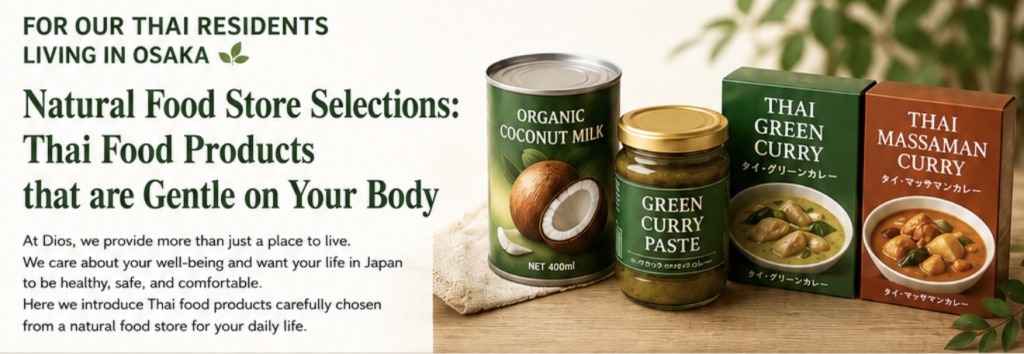
The products introduced here include:

  • Organic coconut milk
  • Green curry paste
  • Thai green curry
  • Thai massaman curry

These are somewhat different from standard convenience-store meals or inexpensive ready-made foods. The products place emphasis on ingredients such as organic coconut milk, organic curry paste, domestically grown vegetables, and Japanese chicken.

They are not identical to the food one would enjoy in Thailand. That is important to say clearly. Still, for those living in Japan who wish to enjoy Thai flavors through ingredients that feel a little more natural and carefully selected, they can be a meaningful option.

Coconut milk and curry paste, in particular, are essential foundations in Thai cooking. In Japan, authentic ingredients are not always easy to obtain in the same way or with the same consistency. In that context, knowing where to find thoughtful alternatives can be genuinely helpful.

An Encounter with the Ideas of Dr. Yanase

These products were found in a natural food store in Gojo City, Nara Prefecture.

The store is closely connected to the ideas of Dr. Yanase, a physician who devoted his life to thinking about how pesticides, food additives, diet, and the living environment affect human health.

His perspective was not limited to simply avoiding pesticides or avoiding additives. It was broader and more fundamental. He saw human life as something shaped not only by medicine, but also by agriculture, soil, water, food, daily surroundings, and even the state of the mind.

His thinking asks us to look again at the way we live. Not only at what we take after illness begins, but at what we choose every day before illness appears. It asks us to value natural cycles, healthy soil, and daily habits that support life in a more balanced way.

That way of thinking still feels relevant today.

What Matters When Choosing Food in Japan

Japan is often seen as a clean and safe country. In many respects, that is true. Food products are managed under laws and standards, and many people feel a strong sense of trust in the food environment here.

At the same time, modern food life in Japan also comes with convenience-driven habits. Convenience-store meals, processed foods, sweet drinks, snacks, instant foods, and ready-made meals are easy to rely on. But when they become daily habits, salt, sugar, oils, and additives can quietly accumulate.

This does not mean that all commercially sold food should be viewed negatively. That would be too simplistic. What matters more is what becomes part of daily life. What you eat often. What you choose repeatedly. What kind of food becomes your routine.

That is where careful selection begins to matter.

How Dios Thinks About “Home” and “Food”

Dios provides furnished residences for international clients. But we do not think of housing as a room alone.

A home is where one sleeps. Where one eats. Where the body recovers. Where the mind becomes calm again. The quality of water, meals, air, cleanliness, and rest inside that home all influence a person’s well-being more than many people first expect.

For Thai residents in Japan, food often carries an added meaning. Thai cuisine is rich in herbs, spices, coconut milk, vegetables, fish sauce, and chili. It is a cuisine with depth, memory, and comfort. Even while living abroad, being able to enjoy familiar tastes through ingredients that feel trustworthy can make everyday life feel more grounded.

This is why Dios values not only housing, but the quality of life as a whole, including food, health, household goods, cleaning, air quality, and bedding.

Product Highlights

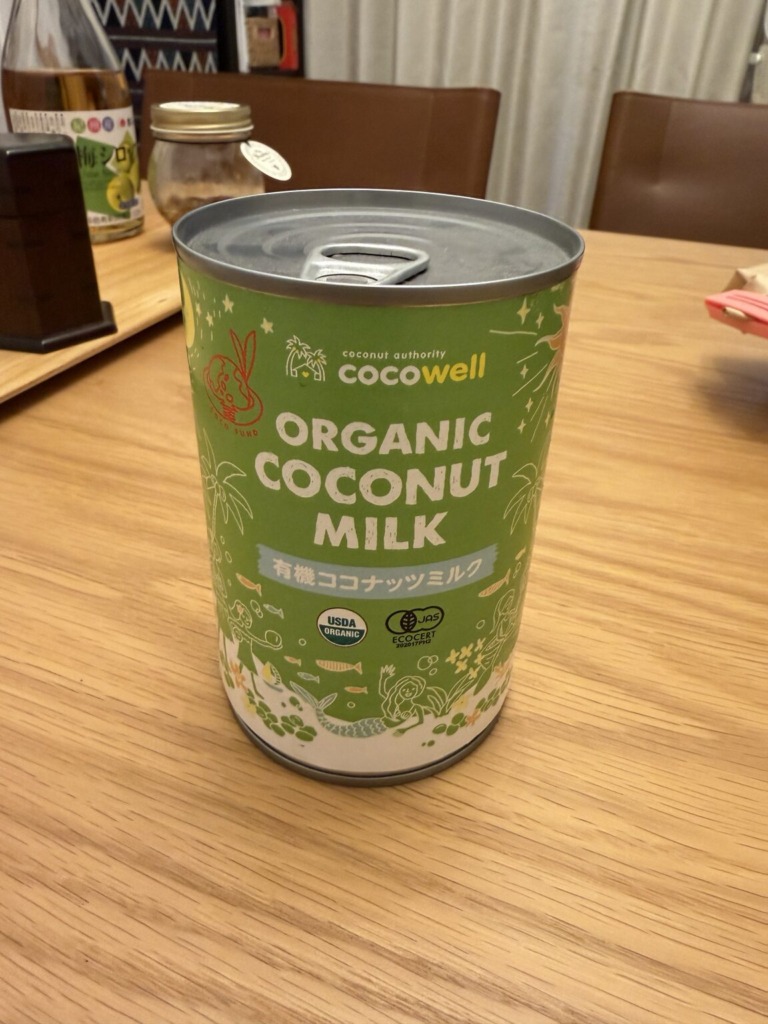
Organic Coconut Milk

This is a plant-based milk made from organic coconut. It is easy to use in Thai curries, soups, and desserts, and offers a natural coconut flavor that feels gentle and balanced.

Coconut milk is naturally rich, so it is not something to consume in large amounts as a drink. But as a cooking ingredient, it can be an excellent addition.
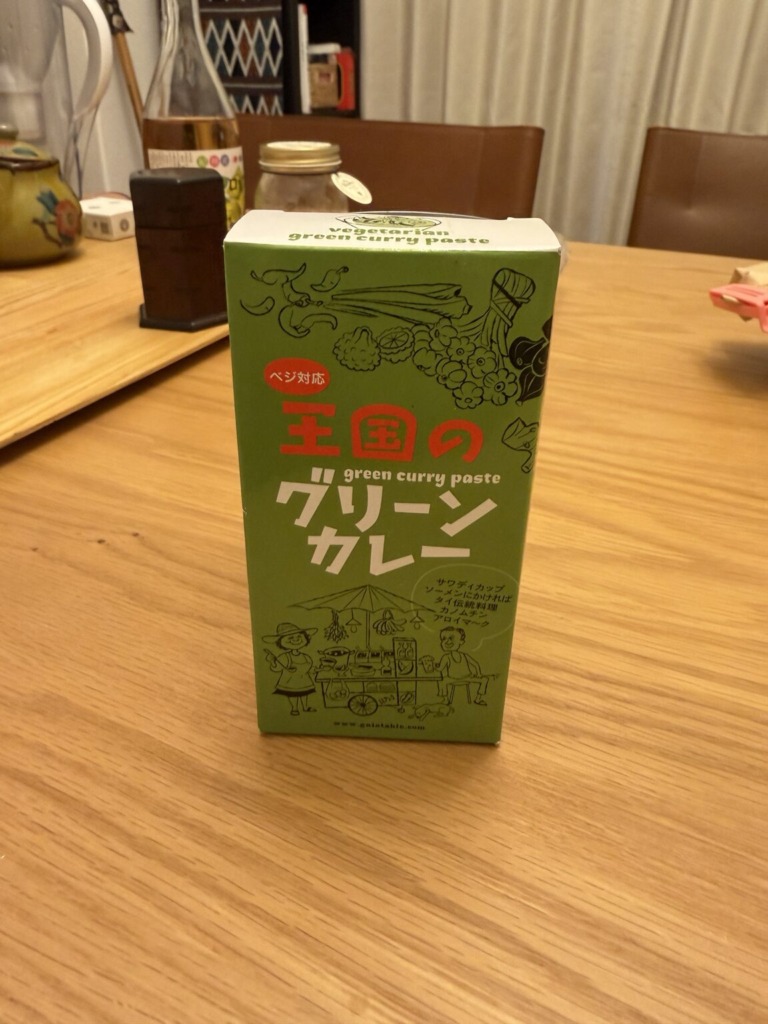
Green Curry Paste

This paste is made with ingredients such as green chili, lemongrass, galangal, kaffir lime, and spices.

It is centered on herbs and spices, giving it a natural aromatic quality. At the same time, curry pastes can sometimes contain a strong level of salt, so moderation remains important.
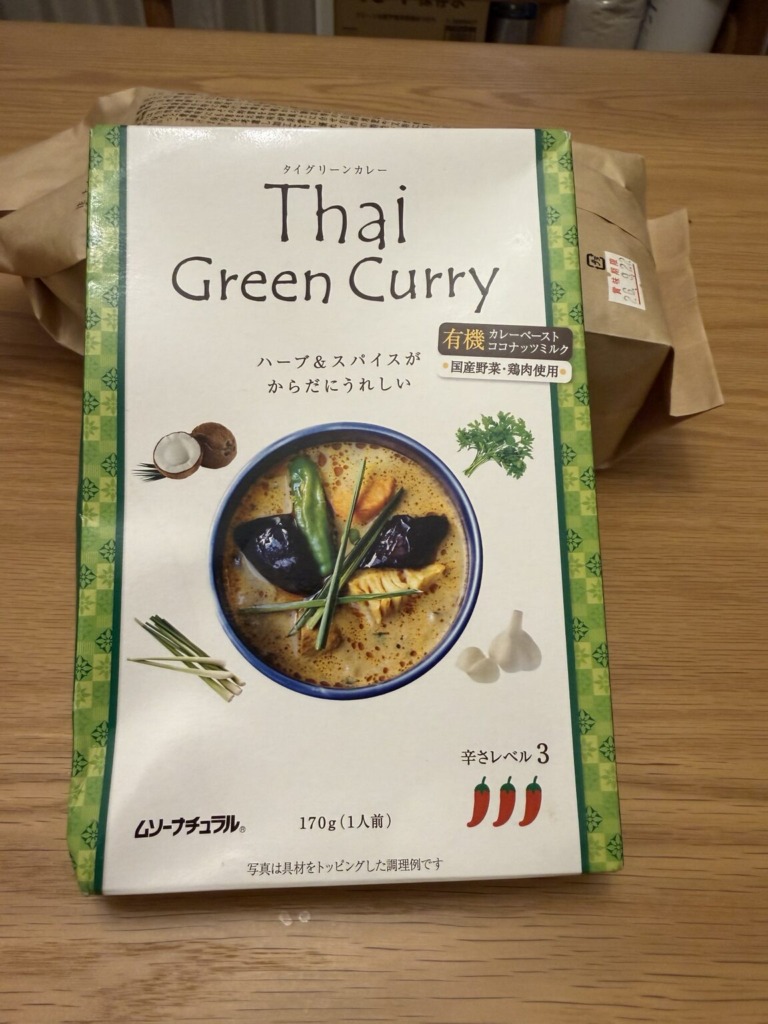
Thai Green Curry

This ready-made green curry uses ingredients such as organic coconut milk, organic curry paste, Japanese vegetables, and chicken.

It offers a practical option for busy days, while still feeling relatively thoughtful in its ingredient selection. However, because it may contain fish sauce and chicken, those who require vegetarian or halal-friendly choices should review the ingredient list carefully.
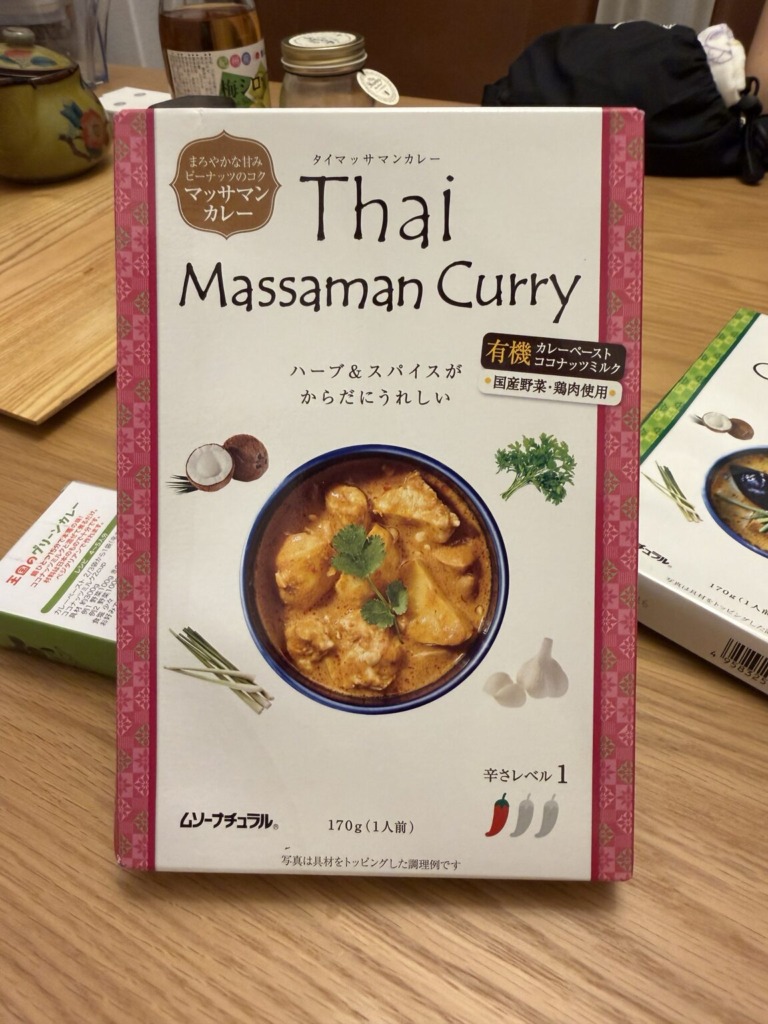
Thai Massaman Curry

Massaman curry is known for its gentle richness, with coconut milk, spices, and peanuts creating a warm and comforting flavor.

This product also appears to reflect the natural food store’s careful approach, using organic coconut milk and organic curry paste. However, because it contains peanuts and cashew nuts, it is not suitable for those with nut allergies.
Important Notes for Thai Residents

These products are carefully selected, but they are not automatically suitable for everyone.

Please pay particular attention to the following:

  • Some products do not appear to carry halal certification.
  • Some include chicken, fish sauce, peanuts, or cashew nuts.
  • Vegetarians, vegans, Muslims, and those with allergies should always check the full ingredient list before purchase.

At Dios, we believe that introducing food should never mean making a blanket statement that something is “good for everyone.” Religion, physical condition, allergies, and food culture all deserve respect.

What We Hope to Offer

For Thai residents living in Japan, a convenient apartment alone is not enough.

A truly supportive life is made of several elements brought together quietly: a comfortable home, food that feels right for the body, clean and orderly surroundings, and someone to consult when questions arise. When these elements are in place, life in Japan becomes not only manageable, but genuinely enriching.

Dr. Yanase considered human life through medicine, agriculture, food, environment, and the mind. At Dios, we continue to learn from that wider perspective. Our goal is to support international residents not only through housing, but through the broader quality of daily living.

Conclusion

For Thai residents in Japan, food is closely connected to both health and emotional stability.

The organic coconut milk, green curry paste, Thai green curry, and Thai massaman curry introduced here may be worth considering for those who want Thai-inspired foods made with more carefully selected ingredients available in Japan.

They may not reproduce the exact taste of Thailand. But for those who wish to enjoy Thai flavors in Japan while paying closer attention to ingredients, they can be a reassuring option.

Dios will continue to offer thoughtful guidance not only on housing, but also on food, health, and the practical culture of living well in Japan. If this way of living speaks to your needs, we would be pleased to hear from you.
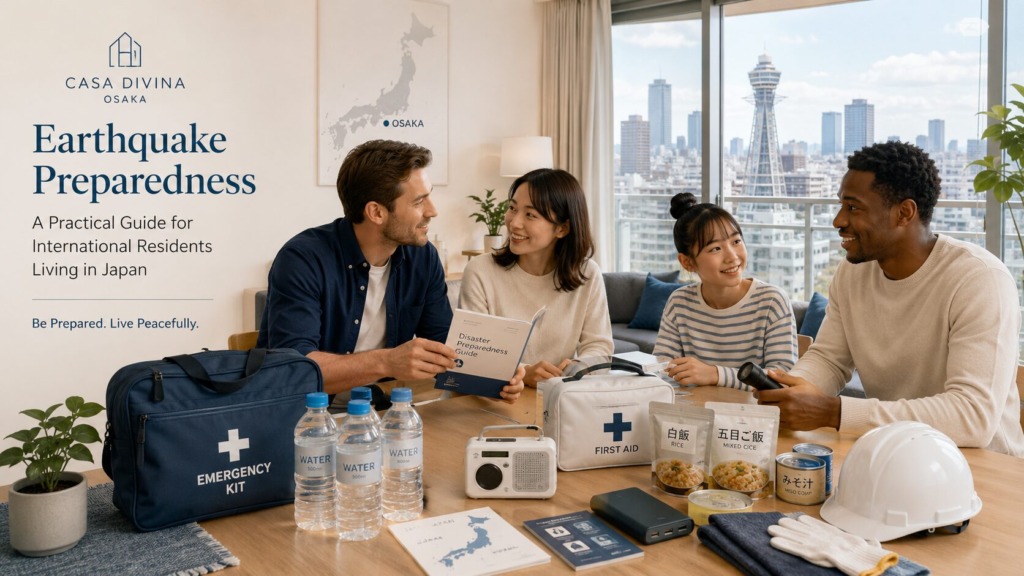
FOR INTERNATIONAL RESIDENTS LIVING IN JAPAN EARTHQUAKE ANXIETY, AND WHAT WE CAN REALISTICALLY DO

By | Life in Japan

THE KIND OF CALM, PRACTICAL DISASTER PREPAREDNESS CASA DIVINA OSAKA BELIEVES IN

Recently, one of our clients connected to a foreign consulate in Osaka shared a concern that many people around them have been feeling: anxiety about earthquakes.

Even for those of us who have lived in Japan for many years, earthquakes are never a light matter. For foreign residents, diplomats, and families newly arrived from overseas, terms such as “seismic intensity,” “tsunami,” and “Nankai Trough” can create a great deal of unease.

Whenever I travel abroad, I also feel a certain tension. Language, systems, emergency information, evacuation sites, medical care, transportation. Things that local residents understand naturally are not always immediately clear to someone from another country.

That is exactly why Dios / Casa Divina Osaka believes its role goes beyond simply providing a residence. We believe that helping our clients live safely and comfortably in Japan also includes practical guidance on daily life, disaster information, and basic emergency preparedness.

WHAT WE WANT TO SAY FIRST

Before anything else, we would like to make our position clear.

There are real questions surrounding the high probability figures and time-based prediction models often used in discussions of a possible Nankai Trough earthquake.

Precise earthquake prediction, in the sense of accurately specifying the time, place, and scale of a future event, is not something current science can reliably do.

At the same time, Japan is a country where earthquakes can happen.

For that reason, we believe it is not wise to frighten people by saying, “It will definitely happen soon,” and it is equally unwise to reassure people by saying, “It will never happen.”

The important thing is to remain calm, think clearly, and prepare in practical ways.

RECENT DISCUSSIONS AND WHY THEY MATTER

In Japan, the possibility of a major Nankai Trough earthquake has long been discussed using phrases such as “a high probability within the next 30 years.”

However, the numbers behind these statements, and the models used to produce them, have also been questioned by some researchers. There are experts who argue that the assumptions behind these models are uncertain, that the calculations depend on contestable premises, and that different methods could produce significantly lower figures.

In other words, the existence of a high number does not automatically mean that the future is known with certainty.

For us, the key point is not to settle an academic argument in a simple blog post.

The key point is this: earthquake-related numbers and forecasts include uncertainty, and they should not be treated as unquestionable truth.

THE NANKAI TROUGH SHOULD NOT BE TREATED AS A CERTAINTY

We believe the Nankai Trough should be discussed with care.

If people hear only that it is certain, immediate, and unavoidable, fear can quickly replace judgment.

On the other hand, it is also not reasonable to conclude that because it has not happened recently, it will never happen.

What we can say is more modest, but more honest.

There are serious questions about whether anyone can confidently state that a Nankai Trough earthquake is highly likely within a specific time frame.

But that does not mean earthquakes will not occur in Japan.

These two ideas are not contradictory.

What we want to avoid is a situation in which the phrase “Nankai Trough” becomes a source of either excessive fear or careless complacency.

EARTHQUAKE PREDICTION IS NOT CURRENTLY POSSIBLE IN THE WAY MANY PEOPLE IMAGINE

For many years, people hoped that earthquakes might one day be predicted in advance.

But despite long research efforts, there has still been no reliable way to identify the exact timing, location, and scale of a major earthquake.

Many supposed warning signs may seem persuasive after an earthquake has already occurred. But that is very different from proving in advance that they can predict one.

This is especially important for international residents.

Statements such as:

“It will happen on this date.”
“This area alone is in danger.”
“After this day, it will be safe.”

These messages may sound reassuring or dramatic, but they often create confusion rather than clarity.

Earthquakes are not that simple.

That is why it is more practical to prepare for the possibility of earthquakes in general, rather than to place trust in specific predictions or rumors.

SCIENCE, POLICY, AND INSTITUTIONS ARE NOT ALWAYS SEPARATE

Recent discussion has also raised another difficult issue.

Some critics argue that earthquake-related public messaging is shaped not only by science, but also by government systems, advisory committees, funding structures, disaster policy, and institutional priorities.

This is a sensitive subject, and it should be approached carefully.

We are not interested in making reckless accusations against specific individuals or organizations.

But it is reasonable to recognize that scientific information in society is often shaped through many layers: research, administration, budgeting, public policy, and media communication.

For that reason, it is wise for readers to receive official numbers and statements with calm attention, rather than unquestioning belief.

This is not about encouraging distrust.

It is about encouraging balance.

HAZARD MAPS ARE IMPORTANT, BUT THEY ARE NOT PERFECT

Hazard maps and risk maps are useful tools.

But they are still tools, not absolute forecasts.

Real earthquakes do not always occur in the places people expected most strongly. Sometimes serious earthquakes happen in areas that were not emphasized. Sometimes places long discussed as high-risk remain quiet.

So hazard maps should be treated as practical references, not as perfect predictions.

For international residents, this is particularly important to understand.

You do not need to panic because a map shows risk.

But you also should not assume that an area is completely safe simply because it does not appear prominently on one map.

Maps are part of preparation. They are not the whole of preparation.

THIS DOES NOT MEAN PREPARATION IS UNNECESSARY

This is one of the most important points we want to make.

Even if high-probability models are uncertain, even if earthquake prediction is not possible, and even if institutional problems exist, it does not follow that preparation is unnecessary.

In fact, the opposite is true.

If specific predictions cannot be trusted, then everyday preparedness becomes even more important.

This is not fear-based disaster planning.

It is life-based disaster planning.

WHAT INTERNATIONAL RESIDENTS ACTUALLY NEED

For many foreign residents, the hardest part is not the scientific debate itself.

The harder question is much more practical:

What should I actually do?

What should I do when an early warning alarm sounds?
Should I leave the building, or stay inside?
Where should I evacuate?
Is my neighborhood at risk from tsunami?
How much water and food should I keep at home?
What happens if electricity stops?
What happens if trains stop?
Where can I find reliable information in English?

These are practical questions.

And they deserve practical answers.

THE KIND OF SUPPORT CASA DIVINA OSAKA WANTS TO OFFER

At Casa Divina Osaka, we want to help reduce this uncertainty in concrete ways.

That means not only providing a residence, but also helping clients understand how to live more securely in Japan.

In terms of earthquake readiness, the support we consider important includes:

Preparation of emergency supplies
Guidance on drinking water, emergency food, flashlights, and mobile batteries
Preparation of portable toilets, hygiene items, and regular medicines
Basic explanations of what to do during an emergency
Sharing earthquake information in English
Guidance on evacuation locations and transportation information in Osaka
Individual consultation when clients feel anxious or uncertain

None of this needs to be dramatic.

It is often enough to keep a little more of what you already use in daily life.

Water. Food. Power. Light. Hygiene items. Reliable information.

Even these simple things can make a major difference to peace of mind.

WHAT CASA DIVINA OSAKA WANTS TO COMMUNICATE MOST CLEARLY

Our position is this:

We should be cautious about treating high-probability Nankai Trough forecasts as unquestionable certainty.

Earthquake prediction, in the sense most people imagine it, is not currently possible.

Scientific discussion, public institutions, funding, and administrative decision-making are often intertwined in complicated ways.

And yet, Japan is still a country where earthquakes can occur.

An earthquake may come.
It may not come soon.
And it may not come where people expect.

That is exactly why we believe in the following approach:

Do not let yourself be overwhelmed by certainty.
Do not become complacent.
Do not trust date-specific rumors.
Value calm, everyday preparedness.

That is the foundation of our thinking.

LIVING IN OSAKA WITH GREATER PEACE OF MIND

Osaka is an international city. Diplomats, corporate executives, researchers, teachers, students, and many others from overseas live here.

That is precisely why Osaka should also be a place where disaster-related information feels understandable and reassuring for international residents.

Casa Divina Osaka will continue to support all those coming from abroad with residences that are clean, comfortable, and thoughtfully prepared, together with practical support for daily life.

Preparedness for disasters is also part of hospitality.

Not to create fear, but to create reassurance.
Not to make dramatic claims, but to think calmly.
Not to become careless, but to prepare quietly.

We believe that this is the kind of service international residents in Japan truly need.

REFERENCES

Japan Meteorological Agency
“On Earthquake Prediction”
Headquarters for Earthquake Research Promotion
“Long-Term Evaluation of Seismic Activity Along the Nankai Trough”
Japan Meteorological Agency
“Information Related to the Nankai Trough Earthquake”
Osaka City
“Inundation Hazard Map for Osaka City”
Prime Minister’s Office of Japan
“What You Can Do Before a Disaster Happens”
Government Public Relations Online
“Key Points for Household Emergency Stockpiles”
Robert J. Geller, “Earthquake Prediction: A Critical Review”
Yan Y. Kagan, David D. Jackson, Robert J. Geller, “Characteristic Earthquake Model, 1884–, R.I.P.”

The Decision Principles of Dios

By | 未分類

What guides our judgments

The work of Dios is built upon countless small decisions made each day.

When selecting a property.

When adjusting contractual terms.

When addressing disputes.

When declining an inquiry.

Each decision is guided by a consistent set of principles.

This page sets out those principles clearly.

Accuracy over speed

We choose accuracy over speed.

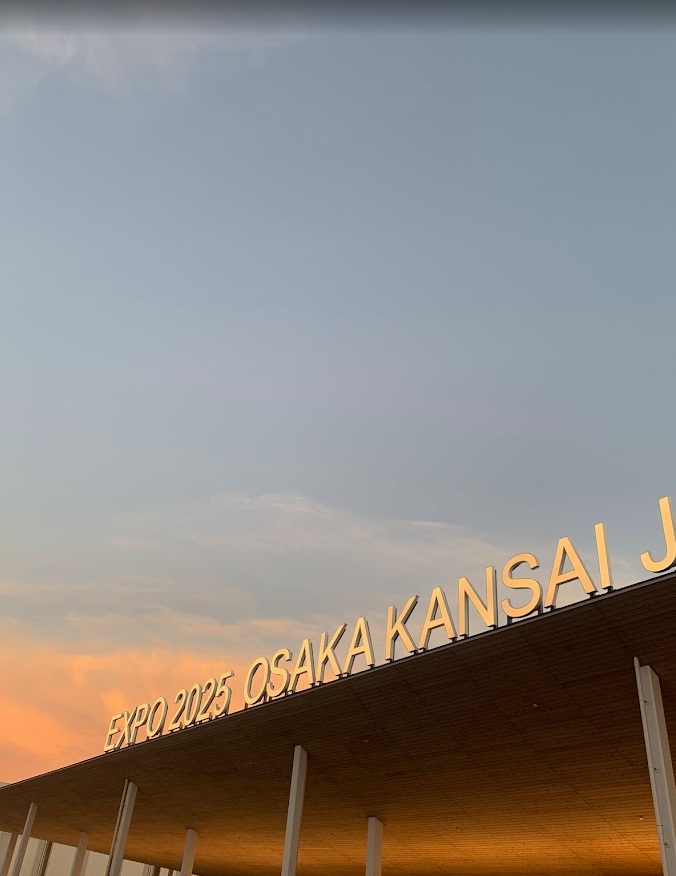
During Expo 2025 Osaka–Kansai,

Dios coordinated large-scale furniture deliveries and removals for numerous international residences within tight timelines.

We are capable of operating at speed when necessary.

However, we do not advance to the next step carelessly or ambiguously.

When explaining contracts, facilities, or conditions, we take the time required to understand the structure, organize the terms, and communicate with technical precision.

Speed is a capability.

Accuracy is a responsibility.

Long-term trust over short-term profit

Even when immediate profit is available,

we do not make decisions that could undermine future trust.

Dios does not operate on a “just this once” mentality.

What we value are relationships that can be explained and respected:

  • Ten years from now
  • Twenty years from now

We do not pursue short-term gain.

We build what we call trust capital.

Structure before emotion

In practice, situations can become emotionally charged.

When that happens, we first clarify:

  • Facts
  • Contracts
  • Conditions
  • Legal frameworks
  • Timelines

We do not deny emotion.

We ensure that decisions are not controlled by it.

Our approach is to create structure that allows fairness and clarity to prevail.

Sustainability over expansion

Growth is not our primary objective.

We do not:

  • Accept more projects than we can responsibly manage
  • Expand beyond the scope where we can assume full accountability
  • Pursue scale at the cost of quality

We prefer steady, sustainable development over rapid expansion.

Integrity

Integrity is not merely kindness.

It means:

  • Explaining unfavorable terms when necessary
  • Declining work that falls outside our principles
  • Acknowledging errors when they occur

Integrity may occasionally cost us in the short term.

In the long term, it strengthens trust.

Trust is accumulated, not declared

Trust cannot be announced into existence.

It is built through:

  • Daily decisions
  • Small commitments kept
  • Accountability consistently demonstrated

Modern economic development depends on:

  • Contract-based systems
  • Governance
  • The rule of law

Osaka has a long history of credit markets, including the Dojima Rice Exchange, one of the earliest organized futures markets in the world.

Dios operates within this tradition of contractual reliability and disciplined trust.

Our role is modest:

to ensure that each individual agreement we manage contributes, in its small way, to a stable and trustworthy international environment.

Warm consideration

Structure and law alone do not create stability.

What completes them is consideration.

We strive to understand:

  • Language barriers
  • Cultural differences
  • The concerns of families living abroad

And to reduce that burden wherever possible.

This spirit of warm consideration is part of our foundation.

A final question we ask ourselves

We regularly ask:

Can this decision be explained clearly ten years from now?

If the answer is no, we do not proceed.

This is our final standard.

In closing

The principles of Dios are not extraordinary.

They are simple:

  • Accuracy
  • Long-term trust
  • Structure
  • Sustainability
  • Integrity
  • Credibility
  • Consideration

What is difficult is not defining them,

but consistently living by them.

We intend to continue doing so.

That is the foundation of Dios.

Why Dios Does This Work

By | 未分類

On housing as a foundation for trust and international life

Dios is a real estate company.

Yet what we truly work with is not property itself, but the uncertainty, responsibility, and human reality faced by foreign residents living in Japan.

Housing in Japan is not simple for foreign residents

For diplomats and expatriates, securing housing in Japan often involves more complexity than expected.

There are differences in:

  • Contract practices

  • Legal frameworks and guarantor systems

  • Language and communication styles

  • Expectations regarding restoration and exit procedures

  • Interior design and living standards

What feels routine to Japanese residents can become a significant source of stress for foreign professionals.

Over decades of practice, we have witnessed how these invisible barriers affect people’s lives.

Housing is not separate from diplomacy or leadership

For diplomats and senior international professionals, housing stability is not merely a personal matter.

It directly influences:

  • Professional focus

  • Family well-being

  • Institutional credibility

  • Bilateral and corporate relationships

When housing is uncertain, even highly capable individuals cannot perform at their best.

Dios believes that ensuring a stable living foundation is a quiet but essential part of international engagement.

We work with lives, not empty units

Dios does not simply introduce empty properties.

We work with the structure of daily life, including:

  • Furniture and interior planning

  • Functional living flow

  • Cultural adaptation

  • Long-term residence management

  • Departure logistics and asset disposition

Our ideal outcome is simple:

A client can arrive in Japan with a single suitcase
and depart in the same way.

Behind that simplicity lies careful preparation, coordination, and ongoing support.

Reducing friction across cultures

Through housing, we seek to reduce friction between:

  • Language and language

  • Country and country

  • Culture and culture

This work is not visible from the outside.
It is rarely dramatic.

But when friction is reduced, relationships function naturally.

Housing becomes more than a contract.
It becomes part of a stable international relationship.

Why we continue

Dios does not do this work for short-term financial gain.

We continue because:

  • Long-term trust matters

  • Accountability matters

  • Decisions must be explainable even decades later

The principles that guided us thirty years ago continue to guide us today.

In closing

Housing is not simply a structure.

It is a foundation for responsibility, credibility, and human connection.

Dios exists to quietly support that foundation for diplomats and expatriates in Japan.

That is why we do this work.

And that is why we will continue to do it.

About Dios

By | 未分類

Quietly supporting the lives of diplomats and expatriates in Japan

Dios is a real estate company.
However, we operate from a position that is somewhat different from what is usually imagined as “a real estate company.”

What we handle is not merely property.
We work with the lives and trust of foreign nationals, diplomats, and internationally active professionals living in Japan.

Although we are a licensed real estate operator,
we do not consider ourselves simply a “real estate agency.”

Dios is a company that provides comprehensive living support services for foreign residents in Japan—
helping them begin their lives smoothly, live with dignity, and leave Japan with the same ease.

For this reason, our services are fundamentally different from conventional rental arrangements that assume empty, unfurnished properties.

A home is more than a physical space

For foreign residents and diplomats in particular,
housing in Japan directly affects their long-term lives in ways that go far beyond accommodation:

  • Stability in professional duties

  • Safety and comfort for family members

  • Trust and credibility as representatives of a country or organization

  • The quality of diplomatic and international relationships with Japan

  • A meaningful and positive cross-cultural life experience

Dios deliberately chooses work that allows us to engage responsibly and sincerely over the long term,
rather than projects that prioritize short-term profit.

Who Dios exists for

Our clients are clearly defined.

  • Diplomats and staff of embassies and consulates

  • Executives and assignees of foreign-owned companies

  • International professionals working across borders

Dios is not a company that serves everyone.
By limiting who we serve, we are able to maintain a high level of responsibility and care for each client.

We exist for those who value understanding, trust, continuity, and a constructive relationship with Japan—rather than price or luxury alone.

During the Expo 2025 Osaka–Kansai, Dios supported housing for international participants from multiple countries and regions.

Looking ahead to 2030, as integrated resort development and Osaka’s International Financial City initiative advance, we aim to work alongside stakeholders to create an environment where international schools and high-quality living conditions support Osaka’s growth as an open and globally attractive city.

Why we do this work

We do this work because, for foreign residents and diplomats, housing in Japan presents uniquely high barriers.

These include:

  • Differences in business customs and legal frameworks

  • Language and cultural gaps

  • Contractual conditions that differ from global standards

  • A lack of housing designed for foreign lifestyles and interiors

  • The significant time and effort required to set up daily life

Through housing, Dios seeks to quietly reduce the friction that arises between:

  • One language and another

  • One country and another

  • One culture and another

In addition, the burden placed on foreign residents—from initial life setup upon arrival to the disposal of furniture, appliances, and relocation upon departure—is far from minor.

Dios provides an environment where clients can arrive in Japan with a single suitcase and leave the same way.
We consider this to be a service of substantial and lasting value.

We are not a company that merely provides empty high-end properties.

Dios works with real estate, interior environments, quality of life, significant reductions in time and effort, and above all, the beauty of human relationships between our clients, the local Japanese community, and our team.

How we work

The way Dios works is intentionally quiet.

  • We do not push sales

  • We do not rush decisions

  • We do not encourage superficial comparisons

Instead, we:

  • Provide careful explanations

  • Prepare clear and accurate documentation

  • Communicate risks honestly

What diplomats and international professionals seek is not speed, but professionalism and certainty. We do not recommend what we cannot clearly explain, and we do not enter into contracts that our clients cannot fully accept.

Our decision-making principles

Our principles are consistent across all decisions.

  • Accuracy over speed

  • Long-term trust over short-term profit

  • Structure over emotion

  • Sustainability over expansion

  • Integrity

  • Credibility

  • A genuine spirit of care and consideration

We do not make decisions that we cannot explain in the future.
These principles are what have sustained relationships lasting ten or twenty years.

In closing

This article is not written for sales purposes.
It serves as a guide to understanding who Dios is and as a framework to prevent misunderstanding.

Everything written here forms the foundation for our decisions and actions.

From this overview branch five more detailed articles, and beyond them, hundreds of observations drawn from daily practice.

Dios is a company that quietly and patiently builds trust over time.

Being Prepared for Diplomatic Housing Needs in Osaka

By | 未分類

In Osaka, housing-related requests from diplomats and consulate staff often arise suddenly and within a limited timeframe.

These situations may be triggered by new appointments or transfers,
changes in family circumstances,
or unexpected issues with an existing residence.

While the reasons vary, what is consistently required is an environment that is
“ready to live in” and “ready to function immediately.”

At Dios, we prepare for such situations in advance.
On a routine basis, we maintain the following readiness:

  • Furnished residences in Osaka, approximately 60–100 square meters, kept available for immediate use

  • Clear preparation, in English, for common challenges in diplomatic housing, including furniture, facilities, cleaning, contractual conditions, and daily living matters

  • An integrated system that addresses cleaning, furniture, contracts, and on-site coordination as a single process

We believe that such preparation is essential precisely because
it is not possible to predict when a consultation will arise.
For this reason, these arrangements are made before any request is received.

When an actual consultation takes place, we take care to
understand the situation thoroughly and
respond in a calm, discreet, and reliable manner.

Dios will continue to make these preparations quietly,
with the aim of supporting international mobility
and the global community in Osaka.