
Tag

Osaka Real Estate アーカイブ - Dios - Executive Apartments for Expats and Diplomats ディオス

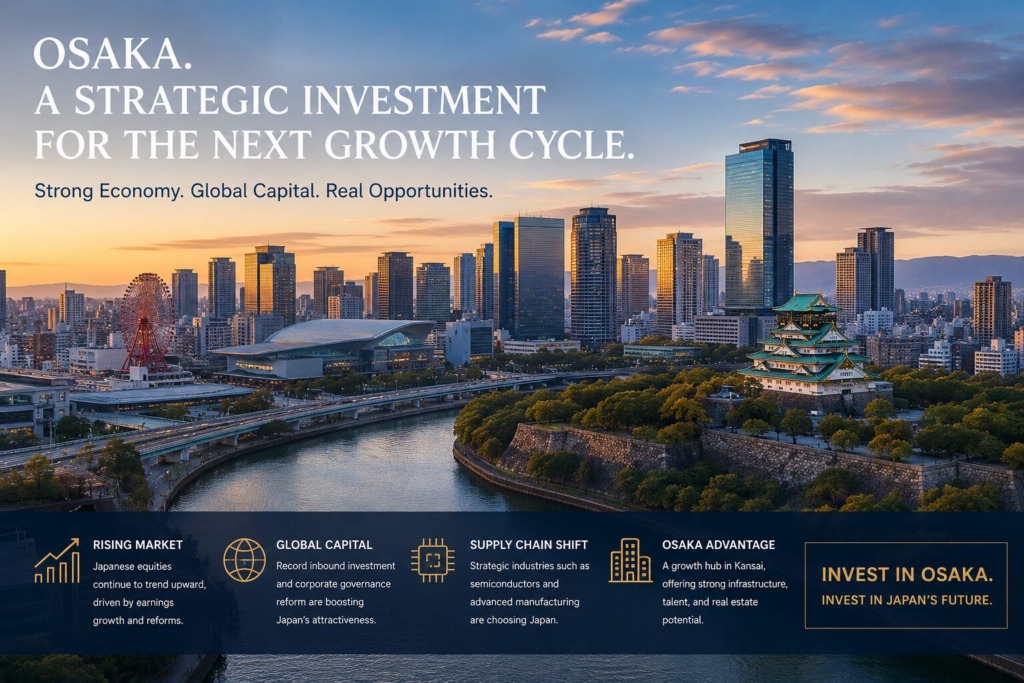
Japan Is Repricing — A Structural Investment Opportunity

By | Investment

Why Japan Is Becoming Increasingly Relevant for Global Investors

Japan is undergoing a structural shift that is attracting renewed global attention.
Rising equity markets, the return of inflation, corporate governance reforms, and geopolitical realignment are no longer isolated developments — they are converging.

This combination is repositioning Japan from a “low-growth, capital-preservation market” into a capital-allocation opportunity.

1. Equity Markets Reflect Structural Change — Not Just Cyclical Recovery

Japan’s equity market strength is not purely momentum-driven.

It is supported by three structural drivers:

  • Corporate profitability at record levels
  • Governance reforms (focus on ROE, PBR, capital efficiency)
  • Sustained foreign capital inflows

These factors indicate that Japanese companies are being revalued based on improving capital discipline, rather than speculative demand.

Importantly, market gains are not uniform. Capital is selectively concentrated in sectors such as:

  • Semiconductors
  • Automation / precision manufacturing
  • Energy transition
  • AI-related infrastructure

This suggests a transition toward a more efficient and discriminating market structure.

2. Inflation Changes the Role of Cash

For decades, Japan’s deflationary environment made cash a rational strategy.

That assumption is now weakening.

  • CPI is rising (particularly in energy and food)
  • Wage growth is gradually emerging
  • Interest rates remain relatively low

This creates a widening gap between:

  • Nominal stability of cash
  • Real purchasing power

Example (simplified):

  • Inflation: 2%
  • Deposit rate: near 0%
    → Real value erosion ≈ 2% annually

This implies that:

Cash is no longer a “risk-free asset” in real terms.

For investors, this shifts the strategic question from:

  • “How do I preserve capital?”
    to
  • “How do I allocate capital efficiently?”

3. Geopolitics Is Repositioning Japan in Global Supply Chains

The U.S.–China strategic competition is accelerating supply chain restructuring.

Key trends:

  • De-risking from China
  • Reallocation of high-value manufacturing
  • Strengthening of allied production networks

In this context, Japan has several competitive advantages:

  • Technological depth (materials, components, precision manufacturing)
  • Political and legal stability
  • Advanced infrastructure
  • Energy and logistics reliability

Rather than a full “reshoring” of Asia, what is emerging is:

A selective relocation of high-value, strategic production into Japan.

This includes:

  • Semiconductors
  • Advanced materials
  • Battery supply chains
  • Data infrastructure

4. Second-Order Effects: Beyond Equities

The investment case for Japan is not limited to equities.

If supply chain and capital inflows continue, second-order effects may include:

  • Wage growth and labor market tightening
  • Urban demand expansion (especially Tokyo / Osaka)
  • Increased demand for high-quality residential real estate
  • Infrastructure and energy investment growth

For foreign investors, this creates multi-layered exposure opportunities:

  • Public equities
  • Private assets
  • Real estate
  • Strategic partnerships

5. Investment Implication: From Passive Holding to Active Allocation

Japan is not yet definitively “the most attractive market in the world.”

However, it is clearly transitioning into:

A market that requires active, selective capital allocation

Key takeaways:

  • Broad exposure is less effective than targeted positioning
  • Cash-heavy strategies face increasing real-value risk
  • Structural themes (governance, supply chains, technology) are critical

Conclusion

Japan is moving from a deflationary, passive capital environment
to an inflationary, allocation-driven environment.

This shift is structural, not temporary.

For global investors, the opportunity lies not in simply “investing in Japan,” but in understanding:

Where capital is flowing — and why.

Disclaimer:
This material is for informational purposes only and does not constitute investment advice. Investment decisions should be made based on individual objectives and risk tolerance.

 

The Era of Information Monopoly Is Over — Now It’s the Era of Design Capability

By | 未分類

A client once believed that requesting property searches from multiple real estate agencies would increase options and therefore lead to a better result.

At first glance, this seems logical.

However, in practice, it did not produce the optimal outcome.

Why?


1️⃣ Japan’s Real Estate Industry Operates on a Shared Database

In Japan, licensed real estate brokers operate through a shared property distribution system called REINS (Real Estate Information Network System), administered by regional real estate transaction organizations.

This system allows brokers to share available residential property information across the market.

Twenty Years Ago Was Different

Before the development of internet-based systems — or in countries where the brokerage industry is not well organized — property information was fragmented. Individual agencies often possessed limited, localized data.

In such environments, contacting multiple agencies was rational.

But modern Japan is different.


2️⃣ Agency A and Agency B Basically Have Access to the Same Information

Through REINS, licensed brokers generally access the same pool of available residential properties.

Therefore, the assumption that:

“More agencies = More property information”

does not hold true in today’s Japanese housing market.

The competitive edge no longer lies in information ownership.


3️⃣ Multiple Agencies Create Information Management Costs for the Client

When a client works with several agencies simultaneously, the client must personally manage:

  • Duplicate property proposals

  • Application priority tracking

  • Communication of condition changes

  • Viewing schedule coordination

If this management is imperfect, disadvantages may arise:

  • Losing application priority

  • Weakened negotiation position

  • Miscommunication of requirements

These are invisible costs — and they are borne by the client.


4️⃣ Portal Site Listings Are Not Confirmed Availability

Public platforms such as:

SUUMO
LIFULL HOME’S

are convenient tools for searching.

However, they may contain:

  • Time lags after properties are taken

  • Already-applied units

  • Outdated conditions

Professional brokers can:

  • Call property management companies directly

  • Confirm real-time application status

  • Negotiate directly with owners

Individual consumers cannot easily perform these confirmations themselves.


5️⃣ The Information Monopoly Model No Longer Exists

Historically, real estate was structured around one principle:

“Those who control information win.”

Today, that structure has disappeared.

Property information is shared.
Exclusivity is structurally limited.
The idea that one company possesses unique residential inventory does not generally apply in Japan.

In residential leasing,

“Only this company knows this property”

is, in most cases, a myth.


So What Is the True Value of a Real Estate Broker Today?

It is not the volume of listings.

It is:

  • The ability to clarify and structure client conditions

  • The ability to filter appropriately

  • The ability to listen accurately

  • The ability to execute reliably

  • Negotiation capability

  • And post-move-in service support


Dios’ Position

Dios has access to the same market-wide property information available to other licensed brokers.

If a client asks,

“Does this property exist?”

we do not answer from the perspective of:

“Is it ours?”

We answer:

“Is it available in the market?”

In today’s environment, information is shared.

What differentiates firms is not access — but capability.

However, this is crucial:

Dios’ core business is not merely property searching.

A typical brokerage’s service ends at key handover.

Dios’ service begins there.

We focus on:

  • Furniture coordination

  • Cleaning and maintenance

  • Ongoing support

  • Exit procedures

  • Repatriation assistance

Housing is not a transaction.

It is an infrastructure for living.


Conclusion

In modern Japan:

Multiple agencies ≠ More information

On the contrary,

Working exclusively with one carefully selected professional leads to better results.

Especially with Dios, exclusive engagement allows us to design properly, coordinate efficiently, and act decisively.

In the internet era, information is shared — not monopolized.

The difference lies in one question:

Who do you design your living strategy with?

Dios is not simply a brokerage.

We are a long-term living infrastructure partner, walking with our clients beyond the contract.